
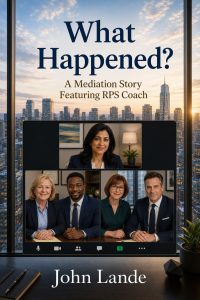
I recently had a rewarding experience discussing a short story, What Happened? A Mediation Story Featuring RPS Coach, with Roger Greenberg’s class on mediation and arbitration at South Texas College of Law Houston. The students’ reactions illustrated how this story can be a valuable teaching tool, portraying a realistic conflict that led to mediation. The story is under 40 pages, and students can read it in about an hour. Unlike the bizarre and often highly unrealistic portrayals of mediation in popular culture, this story offers a realistic picture of how mediation actually works.
The story follows a commercial dispute between two companies whose business relationship deteriorates after problems arise in implementing a software system. Seven chapters trace the development of the relationship, the emergence and escalation of the conflict, the parties’ efforts to address it, their preparation for the mediation session, the mediation session itself, and the aftermath. The story includes optional scenes illustrating the characters’ interactions in more detail. It also includes the parties’ contract, mediation memos, and a memorandum of understanding.
What Can Students Learn from the Story?
The story provides opportunities for students to consider many aspects of professional practice, including:
- How conflicts are transformed into disputes
- Organizational dynamics affecting conflicts and disputes
- Lawyer-client relationships and how lawyers and clients view each other
- Client counseling
- Professional responsibility and judgment when lawyers are under organizational pressure
- Consideration of possible court outcomes
- Case evaluation using litigation interest and risk assessment techniques
- Factors affecting selection of mediators
- Preparation for mediation sessions
- Pre-session mediation memos
- Cooperative and adversarial styles of lawyering
- Managing emotions and repairing damaged relationships
- Negotiation planning and sequencing issues
- Use of private and joint sessions in mediation
- Identification of interests and development of settlement options
- Mediation strategies
- Settlement agreements
- Use of Zoom, AI, and other technologies
- Reflection after mediation sessions
Faculty can emphasize different topics depending on their course objectives and students’ interests. The story provides a common factual foundation for examining these issues and considering how professionals make decisions in complicated situations.
The students’ reactions were encouraging as they drew different lessons from the same material. In the following account, students are identified with pseudonyms to protect their privacy.
A Realistic and Engaging Story
Several students connected the story to their own experiences. For example, Marcus worked on a commercial case last summer with an “eerily similar” fact pattern.
Trevor described how his girlfriend works with companies integrating older software systems into new ones. He said that the story captured the difficulties of integrations like these and how the people involved feel pressured.
Eric had worked on a finance team integrating acquired companies into existing financial systems. He recognized the complications and workarounds depicted in the story, describing the integration process as “a nightmare.” He said the story was “very practical” for him.
Claire connected the story to her divorce mediation experience. Recognizing that, as in her experience, the mediator sought to help the parties reach a mutually satisfactory resolution and avoid potentially unproductive litigation.
Several students also commented favorably on the experience of reading the story. Claire appreciated the writing style, saying that the narrative kept her engaged. She thought the AI-generated illustrations fit the story’s theme.
Rachel compared the story to the cases students read in other classes, saying it helps them “really see the principles and how things work.” Asked whether the reading was too much for one class, Eric said it wasn’t. He said the narrative was easier to follow than judicial opinions, saying that it had a “natural flow” that made it easy to understand what was happening.
Understanding How Mediation Works
Students noticed both broad mediation principles and specific techniques. They recognized that effective mediation involves preparation, understanding interests, developing options, managing relationships, and making strategic decisions throughout the process.
Rachel noted that people are shaped by their experiences and that mediation is an unfolding process. Nathan said the story reminded him that lawyers negotiate throughout litigation, such as during discovery, even though he had never thought of that as related to mediation. Eric said the story reinforced his understanding that mediation can take an entire day as parties work through substantial disagreements.
Sophia appreciated how the mediator, Rami Sinclair, gathered information through preliminary conversations with the lawyers and reviewed their mediation memos before the mediation session. Sophia recognized familiar elements of the mediation session, including private meetings, joint meetings, and arrangements to ensure that no one would leave before the scheduled end of the session.
She particularly appreciated the sequence in which Rami addressed the issues during the mediation session. Rami began by exploring possible arrangements for completing the software project, and she discussed a contentious claim for $100,000 in compensation after the parties had made progress on other matters.
Relationships, Emotions, and Professional Judgment
The story illustrates how legal disputes involve people with histories, emotions, relationships, and pressures that affect their decisions.
Nathan noticed how the pressures of the commercial dispute affected the relationship between the two business representatives. They initially had a friendly working relationship, but their interactions deteriorated as the software problems continued. Similarly, Trevor appreciated how the story showed the pressure of managing a difficult project and how that pressure could turn previously friendly business associates into adversaries.
Nathan connected the story to advice from his sister, who is a practicing attorney. She emphasized the importance of maintaining good relationships with lawyers on the other side of a dispute. She said that cases are often easier to resolve when the lawyers have constructive professional relationships.
Eric focused on the mediator’s handling of emotions. He appreciated a scene in which Rami de-escalated the conflict by redirecting the parties away from arguments about the past and toward what might work in the future. He doubted that AI would be as effective at this. When AI tries to talk him down from something, he said, “I barely take it seriously, but I do take humans seriously.”
Brian discussed organizational pressures on lawyers. In the story, an in-house lawyer is pressured to approve a contract quickly. Brian sympathized with the lawyer but thought he should have asserted himself more forcefully, insisting on sufficient time to review the agreement. At the same time, Brian recognized that the lawyer’s conduct was realistic and illustrated the difficult situations that young lawyers may face.
Opportunities and Challenges of Using AI
Several comments concerned the use of AI in professional practice. The story includes several scenes in which the executives, lawyers, and mediator consult RPS Coach to analyze the situation. Brian noted how lawyers and business professionals could use AI as a sounding board before sending a heated email or making a decision in the heat of the moment.
Rachel observed how AI can help parties identify their interests. She appreciated how RPS Coach helped participants move beyond “the pointing fingers, the blame game” and assess their own risks and positions as well as those of the other side.
Claire appreciated how Rami used RPS Coach. She observed that the mediator had ideas about how to conduct the mediation and used the AI tool to check and reinforce her thinking. She noted that Rami wasn’t using RPS Coach “as a crutch.”
Sophia noticed how Rami used RPS Coach to develop three possible settlement options involving 30-, 60-, and 90-day system verification periods. These alternatives helped the parties consider practical ways to resolve their disagreement.
Daniel was surprised by how readily the parties accepted AI’s involvement in their decision-making. He wondered whether people in actual disputes would be so comfortable with using AI, particularly when one side might be less open to it than the other. His observation raised an important practical question about how lawyers and mediators should address participants’ concerns about using AI.
Different Students, Different Lessons
It was fascinating to see how differently students responded to the same story. They brought their own experiences, interests, and developing professional perspectives to the reading. As a result, they noticed different things and learned different lessons.
Some students focused on mediation preparation, settlement techniques, relationships, emotions, organizational pressures, or the use of AI. Others evaluated particular decisions made by the characters, identifying what they found effective or what they thought the characters might have done differently.
The story provides a richly developed factual situation that gives students a common foundation for discussion while allowing them to explore different questions and reach different judgments.
The story can be downloaded for free. Another post describes various ways faculty could use it in their courses and includes a link to a teacher’s manual.
