
Many people fear that artificial intelligence (AI) will undermine human skills, making them less capable of exercising independent judgment. They worry that machines take control and humans lose control.
Sometimes that’s exactly what happens.
This problem, in my view, is not primarily that AI is too powerful.
The problem is that some people don’t recognize and exercise their power in deciding whether and how to use AI tools. The key issue is how people manage the relationship between human judgment and AI capabilities.
Humans sometimes use AI passively – accepting outputs uncritically, contributing little independent thought, and surrendering responsibility for exercising their judgment.
Surrendering as Zombies
In other words, they drift into what I call “zombie mode.”
Zombie mode is using AI tools mindlessly. Users don’t take responsibility for evaluating assumptions, questioning recommendations, or deciding what – if anything – to do with AI outputs. In zombie mode, people may not even realize how much AI tools are shaping their assumptions, framing choices, and influencing decisions.
That risk becomes especially important as AI systems become increasingly “agentic” – making decisions and taking actions with less direct human involvement. Some agentic capabilities can be very useful when people structure and supervise them thoughtfully. But they also create a temptation to let AI do the thinking.
Taking Control in Centaur Systems
In this new article, I argue that people should use AI tools as part of “centaur systems.” In classical fables, a centaur is a hybrid creature combining human and animal characteristics. The image of a half-man, half-horse embodies the idea that combining complementary strengths can accomplish what neither part could achieve alone. In modern discussions of technology, the term describes teams in which humans and AI tools work together.
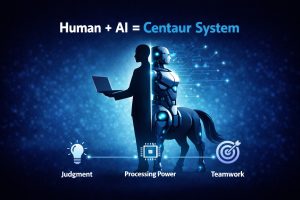
When people use AI as part of centaur systems, they often can achieve better results than humans or AI tools operating independently. Centaur systems combine human and AI capabilities so that each contributes complementary strengths in decision-making. AI helps generate ideas, organize information, analyze patterns, identify risks, and expand perspectives. Humans remain responsible for judgment, values, ethics, context, relationships, and decision-making.
In centaur systems, AI is a collaborator with humans, not the controller. Effective centaur systems involve continuous interaction in which humans question, evaluate, revise, and refine AI outputs rather than merely accepting them.
Many people legitimately worry about the zombie problem. Faculty worry that students may become “de-skilled” by passively using AI tools. Professionals worry about over-reliance on algorithms. Organizations worry about people accepting outputs without sufficient scrutiny.
Humans Taking Responsibility
This all can happen – IF people don’t take responsibility to exercise their independent human judgment.

As AI systems continue to evolve, humans need to learn how to avoid becoming zombies while using them. We can achieve much more – while maintaining control – if we use AI as part of centaur systems.
Take a look.
