
As readers of Indisputably know well, I travel with students every other year to Israel to study conflict close up and to learn from those on the ground about their perspective directly. This year’s trip occurred in January and students wrote reflections last month about what they had seen, learned, and hoped for in the future. It is unfortunately timely to post these as we are yet again engulfed in conflict.
This first blog post reflected on the theme of negotiation and outlines the various speakers that we met with during the two week trip–definitely a highlight was to spend time with the students in the Haifa Mediation Clinic as well!
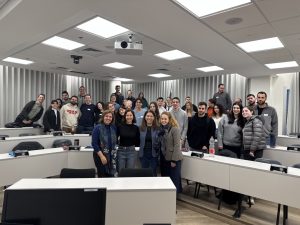
Negotiation is a fundamental aspect of alternative dispute resolution. Of primary importance in the negotiation process is the ability to listen to one’s counterparty with such a degree of active and high-quality listening. Enter Guy Itzchakov, an associate professor at Haifa University, who studies how the experience of empathic and non-judgmental listening impacts speakers’ emotions and perspective. Guy provided a detailed look at what high-quality listening looks like in action and how doing so can direct conversations and impact the emotional states of those involved in a conversation. We discussed the lack of education in this area of listening. Law students are trained to read and write with such precision but are not taught how to listen properly and engage with others as listeners rather than as speakers. We are trained to think at a fast pace and prepare responses quickly as though we are in court, but turning off this mindset in our daily lives, to think more slowly, pause before responding, and only do so after preparing a thoughtful response rather than the first response, is a skill to be learned and practiced. Such responses can direct where the conversation will go. In contrast to our experiences with other speakers, Professor Itzchakov turned the second half of the hour into a workshop in which we trained our listening skills. During one round, we were instructed to listen to the speaker silently, without commenting or asking any questions, which is much more difficult than one might think. In another round, we were required to randomly interject and ask questions completely unrelated to our partner’s story. This experience forced us to consider the messages we convey through our eye contact, questioning, and body language during a negotiation, both in isolation and when taken together.
These skills were apparent in our meeting with Moty Cristal, a retired Lt. Colonel in the IDF, with extensive operational experience in crisis negotiation, who lectures worldwide on crisis negotiation and complex crisis management. He spoke with us and summarized all that we had learned, and in doing so exhibited the skills Guy Itzchakov educated us on, such as reflecting on what we told him and formulating educated responses, which directed the flow of the conversation. Moty was able to hear from many students on our collective experiences and synthesize our accounts into a large narrative of what occurs in the Middle East region and how negotiations proceed based on our newly learned knowledge. A memorable moment with Moty Cristal was our discussion of the meaning underlying “justice”. He argued that the definition of justice held different opposing meanings for each party to the conflict. Because of these irreconcilable differences, it is better to be more concrete and less idealistic when thinking about how to proceed with negotiations. Most notably, he highlighted a sharp difference between the negotiation theory we are taught in American schools, in contrast to the theory he has applied in his experience negotiating with representatives from neighboring nations, in which little to no trust exists on both sides of the table.
We also spent time with the Haifa University Mediation Clinic students. The students, who came from very diverse backgrounds and upbringings, explain their perspectives about conflict and negotiation based on their living in an embattled and uniquely divided country. We divided into smaller groups, which provided each student the opportunity to further delve into their personal experiences and elaborate on how they approach conflict in their daily lives. Along with the traumatic events of October 7, 2023, we discussed the changes Haifa University implemented to its speech policy to address sensitive discourse within the school. As Israel’s most diverse university in one of its most diverse cities, the school was thrown into disarray shortly after October 7th. Jewish, Christian Arab, Muslim, and Palestinian students came back to school feeling isolated and as though their respective concerns were left unaddressed. The administration and student representatives created a framework incorporating negotiation tactics that applied to students and faculty alike, to allow students and faculty to express their opinions without “crossing the line” into unnecessarily offensive or other harmful language.
Finally, Daniel Taub, an Israeli diplomat, international lawyer and writer of British origin, educated us on the Jewish tradition of civil debate and disagreement. He explained that a Jewish negotiation is an argument for the sake of heaven based on the principles of examining truth. He elaborated that larger negotiations have three perspectives at play simultaneously: parties across the table, negotiations along the same side of the table, and negotiations behind the table with the stakeholders. He also added his own new fourth element— negotiations within each negotiator’s heart. We enjoyed hearing him speak about negotiating with family members, as he noted that not every conflict needs to be resolved, especially with family members whom we see often. Hearing his approach to conflict and negotiations provided us with interesting nuances and taught us how negotiation varies depending on the parties involved.
