
Students at Cardozo had the pleasure of hearing from a diverse and impactful group of speakers during their trip to Israel. A common theme among many of the speakers and lecturers concerned the impact of the Israeli judiciary, social institutions, and non-profit organizations in Israeli politics on a national and international stage.
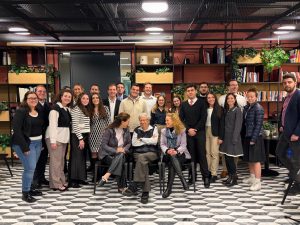
Professor Rivka Weill of Reichman University discussed the hotly contested issue of Haredi (“Ultra-Orthodox”) men’s exemption from military service in Israel, which has created civil unrest and animosity toward the Ultra-Orthodox community in Israel. She emphasized that the current blanket exemption afforded to the Haredi community is not feasible in light of the growing birth rate among the Ultra-Orthodox compared to the much lower birthrate of secular Israelis. Additionally, she explained how many Israelis who don’t enjoy status-based exemptions feel that the current system is unfair and unreasonable. Not only did Professor Weill offer a deep legal and constitutional analysis of the issue, but she was also extremely effective in explaining the underlying tensions and practical implications of the debate. She presented a particularly thoughtful and nuanced approach to addressing the conflict, suggesting that a potential solution could involve offering Ultra-Orthodox men alternative pathways to service. These accommodations could include enlistment in all-male units, adherence to strict kosher standards according to their own religious practices, and placement in non-combat or civilian-support roles within the military framework.
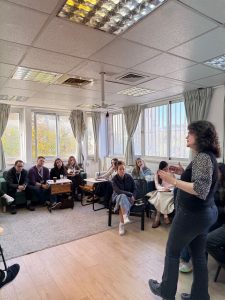
Students had further opportunity to hear from sitting Supreme Court Justice Daphne Barak-Erez, who offered a first-hand perspective on calls to change the structure of the Israeli judiciary. Justice Barak-Erez provided an especially personal and reflective account of the role of a judge within Israeli society, with particular emphasis on the responsibilities of a Supreme Court Justice. She highlighted the unique features of Israel’s judicial system, noting that individuals and organizations have the ability to bring cases directly before the Supreme Court as a court of first instance—a structure that stands in contrast to the American judicial model, where our Supreme Court retains only appellate jurisdiction. Justice Barak-Erez explained how although this system is advantageous to the extent that the Supreme Court can resolve more cases with finality, its drawbacks include, among other things, confronting a docket of about 12,000 cases per year (compared to the 70–80 cases heard annually by the United States Supreme Court).
Students were fortunate to meet former Supreme Court Justice Aharon Barak, who held an informal question and answer session with students from Cardozo. He focused the conversation on issues of Israeli judicial reform and Barak’s personal experience of sitting on the International Court of Justice. This experience was especially enlightening, as Justice Barak spoke candidly about the personal and professional sacrifices he made in defending Israel’s legal position before the ICJ. The session also gave students a rare opportunity to engage directly with one of the most influential justices in Israeli history, whose judicial philosophy has profoundly shaped Israeli society and the development of its constitutional framework.
Students also gained firsthand exposure to how Israeli social institutions continue to address issues of inclusivity among the many diverse communities in Israeli society. In a tour of the National Library of Israel, students learned that it was established with the vision of it being a safe and open public space for all citizens of Israel to meet and congregate. As such, the library has taken steps to not only accommodate all the diverse sects of Israeli society but has gone above and beyond to accommodate each groups’ needs. For example, Professor Raquel Ukeles spoke with students about how the library requires an email address for each person who wants a library card. Because people in the ultra-Orthodox community in Israel don’t usually have access to an email address, the library has generated hundreds of email addresses and makes them available to those who do not have a personal email address to use, ensuring equal access and inclusion to the public library. This inclusion effort, she said, as illustrated in the generation of email addresses, is only one manifestation of the time and effort that members of the Israeli government have exerted on behalf of the diverse communities that call Israel home.
Other discussions throughout the trip centered upon the work of non-profit organizations in the practice of promoting peace and collaboration internally in Israel and externally between Israel and its neighboring nations. For instance, we had the pleasure of hearing from Dan Feferman, co-chairman of Sharaka, who provided a profound understanding of the shifting tectonic plates in Middle East geopolitics. Dan’s organization, Sharaka, meaning “partnership” in Arabic, focuses on building bottom-up peace through people-to-people diplomacy. Additionally, students heard from Itach Maaki, an organization that advocates for the equality of women’s rights in Israel. Speakers from Itach Maaki discussed their vision in which Israeli law reflected the unique perspectives of women from all social, national, geographic, ethnic, and economic groups.
One of the fundamental themes of the students’ trip in Israel that was interwoven throughout their experiences reflects the diversity institutions and organizations shaping the Israeli political discourse. Students can apply these experiences to their upcoming studies in law school, legal careers and beyond.
