
Clearly as we watch what is unfolding now, the experiences from October 7th continue to inform Israeli policies and politics. Here are student reflections on our visits to the Nova site and Kibbutz Nir Oz as well as meetings with hostage Gadi Moses, Professor Jonathan Dekel-Chen, whose son was held hostage, and Dr. Cochav Elkayam-Levy, the head of the Civil Commission on Hamas Crimes Against Women and Children. Below are the student reflections on each of these visits–for me, hearing from released hostage Gadi Moses was particularly inspiring. His statement, “anger is not in my toolbox” was an incredible expression of hope and belief in the future.
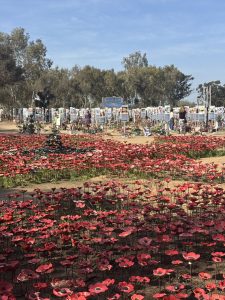
The events of the October 7th massacre against Israeli civilians in the Gaza envelope expose the fundamental truth that bearing witness is the means by which atrocity can be prevented from disappearing into history. The magnitude of the tragedy that occurred on that day extends beyond casualty statistics. Institutional documentation, survivor testimony, and physical sites of violence all transform the abstract into a concrete human reality that cannot be denied or forgotten.
Dr. Cochav Elkayam-Levy leads the Civil Commission on October 7th Crimes by Hamas Against Women and Children, an organization dedicated to documenting war crimes against the family unit and gender-based violence. Her team of lawyers, trauma experts, and researchers is compiling an airtight report that introduces kinocide: the deliberate targeting of families through physical and psychological terror, often broadcast via victims’ own devices. The forthcoming report is vital not only to preserve truth but to establish an undeniable historical and legal record, ensuring the evidence is impossible to ignore.
Jonathan Dekel-Chen, an American-Israeli professor whose son Sagui spent 498 days in Hamas captivity, offers an urgent vision for Israeli-Palestinian peace. Rather than creating new hatred, the war cemented multi-generational animosity that makes peacemaking exponentially harder. He believes lasting peace requires religious leadership, not politicians, because religion fuels the conflict’s most destructive forces that only religious authorities can extinguish. Peacemaking demands “people with real skin in the game,” not detached intellectuals, performative activists, or academics divorced from lived stakes. Even while his son remained imprisoned, Dekel-Chen refused to abandon his work as a peace advocate.
Kibbutz Nir Oz was home to peaceniks – individuals committed to coexistence with peace with Palestinians, yet they were among those most brutally targeted by Hamas terrorists on October 7th. Walking through the Kibbutz, it was impossible to ignore the great contrast between the serenity and natural beauty of the place and the severe devastation inflicted upon it. Burned homes, shattered windows, and smashed dinner plates remained frozen as if a scene in a horror movie had been cut short: everything left exactly where violence interrupted it.Speaking with Gadi Moses, who was kidnapped from his home on the Kibbutz, and hearing about how he was held captive for 482 days under cruel and inhumane conditions was profoundly unsettling. Yet, what was most striking was not what Gadi endured, but who he is despite it. His wife was murdered during the horrific attack, along with many of his neighbors and close friends. Yet, he spoke with optimism about rebuilding his community and moving forward, explaining that anger is not in his toolbox.
As in the Kibbutz, at the burned and pillaged site of the Nova Massacre, it was tragic to see that those who most wanted to make peace with their neighbors were the ones senselessly slaughtered before they could see their dreams of living in harmony fulfilled. Reading the stories of the lives that were taken too soon, as well as the way these souls touched many others, left only two positive messages: they will never be forgotten, and we will dance again.
Schneider Children’s Medical Center is the hospital to which the child hostages arrived upon their return to Israel. It is a testament to resilience, shared humanity, and the possibility of dignity in the shadow of war. The doctors and nurses who are of every faith unite to care for the sick children and support their families. At Schneider, coexistence is evident when a Hasidic family and a Muslim family share a hospital room, and conversations form over their children’s medical treatment.
The documentation of October 7th is no academic exercise or political statement. The attacks demonstrate that human suffering must be acknowledged, recorded, and remembered. From Dr. Elkayam-Levy’s legal documentation to the living testimony of survivors like Gadi Moses and Sagui Dekel-Chen, to the quiet heroism of staff at Schneider Hospital, and to the haunting ruins of the Nova Site and Kibbutz Nir Oz, each thread of evidence weaves together an irrefutable tapestry of truth. These efforts ensure that the massacre cannot be erased, minimized, or distorted by those who would prefer convenient narratives over inconvenient facts. The shattered homes and lives demand our witness, documentation, and commitment to preserving historical truth. In bearing witness, we protect the living and safeguard the future from those who would prefer to repeat history’s most evil chapters. Documentation is the work of memory, and memory is what is needed to prevent both erasure and repetition.
