
Some faculty are wary of using artificial intelligence (AI) in scholarship and teaching. Some are reluctant to use it because they worry that it may undermine thinking, writing, and teaching. Others worry about using AI in ways that effectively delegate too much intellectual work to the technology.
There is another possibility. You can use AI as part of a “centaur system.” In centaur mode, humans use AI to get results that are better than humans or AI tools can produce operating independently. Unfortunately, some people use it in “zombie” mode, deferring to outputs uncritically, contributing little independent judgment, and failing to evaluate important assumptions, risks, or alternatives.

Recently, I was invited to speak at the University of California, Davis Law School about practical ways that faculty can use AI in their scholarship and teaching. This PowerPoint from my presentation provides a brief overview of these ideas and links to additional resources. Here’s the video of the presentation.
Using AI in Scholarly Writing
One reason that faculty are sometimes disappointed with AI is that it often produces generic responses. AI generally works better when it understands both the writer and how the writer wants to collaborate with AI.
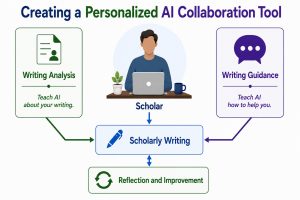
You can address this problem by developing a personalized AI Writing Collaboration Tool that combines two documents to tell AI how it can help you with your writing. The first is a Writing Analysis document that helps AI understand your writing, scholarly interests, goals, and stylistic preferences. The second is a Writing Guidance document that teaches AI how you want to collaborate throughout the writing process, including brainstorming, organization, drafting, revision, substantive review, and copy editing.
You can use your personalized AI Writing Collaboration Tool to help you improve your writing while preserving your judgment, voice, and intellectual control throughout the writing process. Of course, you should comply with any applicable institutional or professional rules about using AI in your writing. Pre-tenure faculty should consult members of their tenure and promotion committees or other appropriate institutional officials to ensure that their use of AI is consistent with applicable expectations and evaluation criteria.
AI can help you produce the best version of what you are trying to say. It can help you clarify your thinking, identify questions and alternatives you might otherwise overlook, and express your ideas more clearly, precisely, and persuasively. Used thoughtfully, AI can enhance rather than diminish your independent judgment, helping you preserve your voice while improving the quality of your work.
A well-designed AI Writing Collaboration Tool can become one of the best editors you have ever had. It can help you generate ideas, sharpen your thinking, strengthen your analysis, improve your prose, and provide careful copy editing and proofreading whenever you need it – all while preserving your voice, judgment, and intellectual control.
I developed my own collaboration writing tool, which has resulted in a quantum increase in the quality and quantity of my writing. (Have you noticed?)
Even if you don’t want to use AI to help with specific writing projects, the Writing Analysis document describes how AI can produce a scholarly portrait by analyzing your writing, scholarly interests, and development over time. This portrait can help you better understand your writing and identify future directions for your scholarship.
Using AI in Teaching
You can also use AI in teaching in centaur or zombie mode. You don’t have to choose between ignoring AI and allowing students or instructors to delegate intellectual work to it. You can use AI intentionally to promote learning, reflection, and skill development.
The presentation describes how you can use AI in exercises for students to check for hallucinations in doctrinal material, prepare for and reflect on simulations, and write course papers. You can adapt these ideas to reflect your own pedagogical goals, discipline, and teaching style.
You don’t have to choose between avoiding AI and using it uncritically. If you’re willing to take the initiative to experiment with AI, you may find valuable ways to improve your scholarship and teaching while preserving your independent judgment and intellectual control.
Take a look.
